
Polyvinyl Alcohol (PVA) is widely utilized in the specialty paper industry as a surface sizing agent, coating binder, and functional dispersant. Selecting the appropriate PVA grade—ranging from standard fully hydrolyzed grades to modified functional variants (e.g., carboxyl-modified, cation-modified, or silanol-modified)—is essential for optimizing film strength, water resistance, pigment binding, and printability across various paper substrates.
1.Introduction to Specialty PVA in Papermaking
Polyvinyl alcohol (PVA) is a water-soluble synthetic polymer recognized for its exceptional tensile strength, film-forming capability, and oil resistance. In specialty paper production, standard grades (e.g., PVA-117, PVA-217) provide basic binding and barrier properties, whereas specialized modified PVA grades address stringent performance requirements such as rapid ink absorption, precise chemical dispersion, and enhanced surface gloss.
2. PVA Grade Selection by Specialty Paper Type
2.1 Inkjet Paper
Inkjet papers demand high liquid absorption, minimal bleeding, and precise ink fixation across multiple functional coating layers:
2.2 Pressure-Sensitive Paper
Pressure-sensitive papers rely on stable microcapsule dispersion and chemical compatibility:
2.3 Thermal Paper
Thermal paper coatings require precise thermal barrier property and pigment dispersion stability:
2.4 Release, Engineering, Art & Kraft Papers
3. Grade Selection Matrix
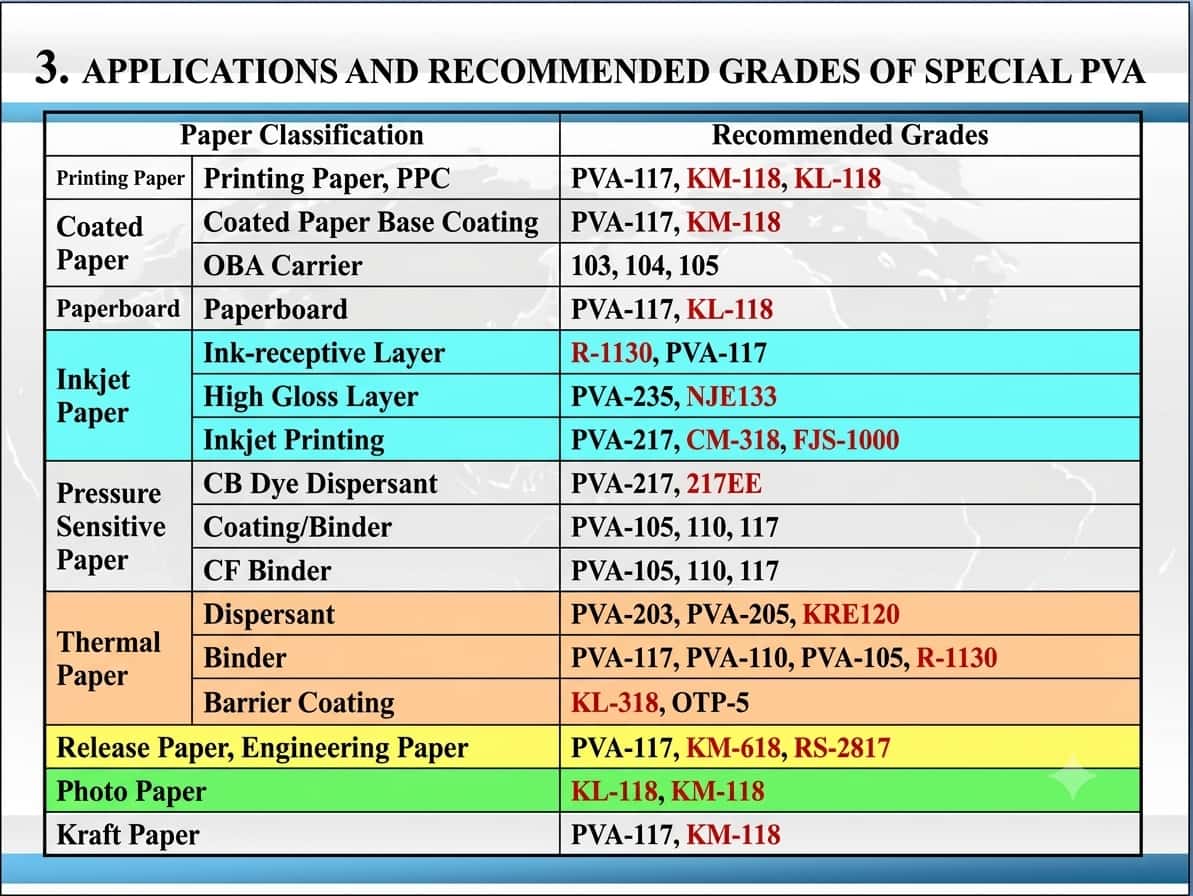
4. Technical Selection Principles
Degree of Hydrolysis:
Fully hydrolyzed grades (98-99%, e.g., PVA-117) deliver maximum film strength, solvent resistance, and moisture barrier properties. Partially hydrolyzed grades (87-89%, e.g., PVA-205, PVA-217) provide superior rewettability, faster cold-water dissolution, and enhanced emulsification.
Functional Modifications :
Silanol Modification (R-Series): Reacts with inorganic silicates/silica in inkjet coatings, creating robust chemical networks for superior water resistance and color fastness.
Carboxyl / Sulfonic Modification (KL/KM/CM-Series): Increases anionic charge compatibility, greatly improving dispersion capability with calcium carbonate, kaolin clay, and latex systems.
Website: www.elephchem.com
whatsapp: (+)86 13851435272
E-mail: admin@elephchem.com



 IPv6 network supported