
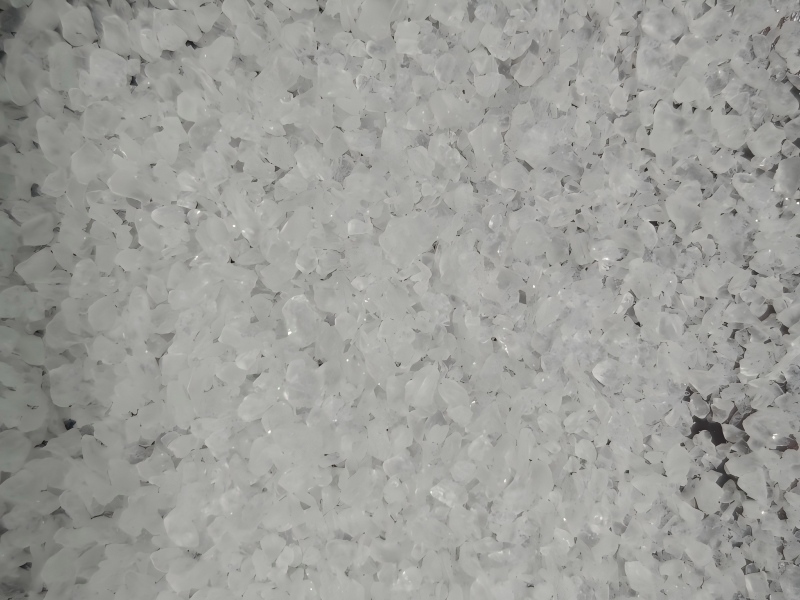
Industrial laboratory evaluations and sieve analysis indicate that Chuanwei (Sinopec Chuanwei Chemical) PVA granules generally exhibit a higher sieve pass rate and tighter particle size uniformity compared to Ningxia Energy Chemical (Sinopec Ningxia) PVA. Chuanwei’s refined milling and mechanical grading yield a narrower particle size distribution (PSD), resulting in less localized clumping and more predictable dissolution rates during downstream processing.
Key Takeaways: Particle Metrics
Technical Analysis: Sieve Pass Rate and Particle Size Distribution (PSD)
In the polymer processing industry, the physical handling of Polyvinyl Alcohol (PVA) is governed by its Particle Size Distribution (PSD). When downstream manufacturers evaluate granules for solution preparation (such as the steel belt casting or drum casting methods), the consistency of the particle matrix determines the thermal and fluidic efficiency of the entire line.
The Screening Profile of Sinopec PVA
Chuanwei Chemical possesses decades of technical iteration in its alcoholysis and post-treatment milling lines. Laboratory screening data reveals that Chuanwei's granules achieve an exceptionally high sieve pass rate within specified mesh specifications. The mechanical screening matrices minimize the presence of two process defects:
The Screening Profile of Ningxia Energy Chemical PVA
Ningxia Energy Chemical utilizes highly modern, massive single-line capacities optimized for massive chemical throughput. Due to the high-velocity output of their secondary milling systems, their particle spectrum tends to be slightly wider. While the bulk of the material falls well within commercial standards, the batch-to-batch variance may carry a slightly higher percentage of fractional fines or variations in grain boundaries compared to Chuanwei's highly calibrated milling standard.
Comparative Data: Granule Metrology Metrics
| Granule Metric | Chuanwei PVA | Ningxia Energy Chemical PVA |
| Sieve Pass Rate (Target Mesh) | High & Stable (Narrow Curve) | Standard (Wider Curve Profile) |
| Granule Uniformity (Visual) | Highly crystalline, regular geometry | Standard granular matrix, minor fines |
| Dissolution Kinetics | Highly synchronized; uniform swelling | Variable; requires tighter agitation control |
| Filter Screen Lifecycle | Longer; minimal unmelted gel bypass | Standard; dependent on blending shear |
How Particle Uniformity Impacts Production
For high-precision applications—such as the manufacturing of optical-grade TAC/PVA display polarizers or micro-filtration membranes—granule uniformity is directly linked to the final product's defect rate.
Preventing Micro-Gels ("Fish-Eyes"): When a batch with low uniformity is dumped into a dissolving tank, the uneven grain sizes cause a mismatch in hydration rates. Small particles dissolve instantly, increasing the local viscosity of the solution, which coats the larger, undissolved particles. This creates micro-gels or "fish-eyes" that are incredibly difficult to break down even with prolonged heating, forcing frequent filter screen changes.
Optimizing Dry Extrusion Stability: In dry extrusion blow molding, irregular grain feeds cause fluctuating bulk density inside the hopper. This can lead to uneven feeding zones within the single-screw or twin-screw extruder, resulting in localized shear variations and thermal degradation.
FAQ: Frequently Asked Questions
Q: Does alcoholysis degree (partial vs. full) affect particle screening uniformity?
A:Yes. Partially alcoholized grades (Polyvinyl Alcohol 1788) possess lower glass transition stability and inherent tackiness compared to fully alcoholized variants (Polyvinyl Alcohol PVA1799). During mechanical milling, partially alcoholized matrices are more resilient and gummy, making precise mesh screening more technically challenging than splitting the brittle crystals of fully alcoholized types.
Q: How can manufacturers counteract lower granule uniformity in production?
A: If processing a batch with a wider particle size distribution, engineers can optimize production by introducing an extended pre-swelling stage at a lower temperature with continuous low-shear agitation before triggering high-temperature dissolution cycles. This ensures all grain scales reach uniform water absorption equilibrium.
Website: www.elephchem.com
whatsapp: (+)86 13851435272
E-mail: admin@elephchem.com



 IPv6 network supported