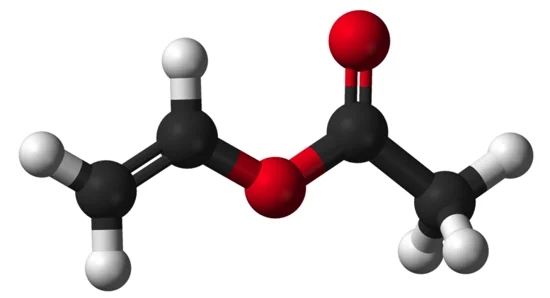
Vinyl Acetate Monomer (VAM) is a critical chemical intermediate widely utilized across the global chemical industry. It serves as an essential building block for manufacturing various resins and polymers that find applications in everyday industrial and consumer goods—ranging from paints and coatings to adhesives, sealants, textiles, and packaging films.
Thanks to its versatile polymerization options, manufacturers can leverage VAM to design tailored products that balance cost-effectiveness with high performance.
1.Major Applications of VAM
Global consumption of VAM exceeds 4 million tons annually, growing at a steady rate of approximately 4.7%. The vast majority of VAM is processed into specialized polymers and copolymers.
Polyvinyl Acetate (PVA) and Derivative Resins
The largest single end-use for VAM is the production of Polyvinyl Acetate (PVA) resins, accounting for over half of total global VAM consumption.
- Properties: PVA emulsions and resins are highly cost-effective, easy to use, and incredibly versatile.
- Common Uses: PVA is famously known as the core ingredient in household white glue used to bond paper, wood, fabric, and plastics.
- Downstream Derivatives: PVA serves as the primary raw material for massive downstream chemical systems, including Polyvinyl Alcohol (PVOH)—which is the largest derivative use of PVA—as well as Polyvinyl Butyral (PVB) and Polyvinyl Formal (PVF).
VAE and EVA Copolymer Systems
One of the fastest-growing application sectors for VAM is the production of Vinyl Acetate-Ethylene (VAE) and Ethylene-Vinyl Acetate (EVA) copolymers. The ratio of VAM to ethylene determines the final material characteristics:
- VAE Copolymers (VAM > 60%): Primarily used in coatings, adhesives, cement, and gypsum. VAE systems are highly favored for formulating low-VOC (Volatile Organic Compound) emulsions because the ethylene monomer acts as an internal plasticizer, eliminating or reducing the need for external film-forming aids. Commercial VAE emulsions generally exhibit a glass transition temperature (Tg) between -15°C and +15°C. These can also be spray-dried into Redispersible Polymer Powders (RDP), often referred to as "solid latex."
- EVA Copolymers (VAM < 40%): These operate as thermoplastics, widely utilized in making elastic films, extrusion coatings, and hot-melt adhesives.
- The 50% Threshold: As VAM content increases in the copolymer, crystallinity and tensile properties decrease, while flexibility, toughness, and adhesive strength improve. At around 50% VAM content, the copolymer becomes completely amorphous.
- EVOH Production: Low-VAM EVA can be further converted into Ethylene-Vinyl Alcohol (EVOH) copolymers. EVOH offers extraordinary gas barrier properties, making it an invaluable barrier layer in multi-layer food packaging, agricultural films, cosmetics bottles, and plastic fuel tanks.
Vinyl Acrylic Copolymers
Vinyl acrylic emulsions offer an economical and highly efficient option for the commercial sector. They are widely specified for interior architectural coatings, caulks, sealants, paper/textile binders, engineered fabrics, and pigment dispersions. Incorporating acrylic monomers—such as ethyl acrylate, butyl acrylate, and 2-ethylhexyl acrylate—enhances the copolymer's flexibility, water resistance, adhesion, scrubbability, and stain resistance. Ter-monomers are also used like ethylene and acrylic acid in these systems.
2. Best Practices for Safe Handling and Storage
Because VAM polymerization is strongly exothermic, an uncontrolled or runaway reaction poses a severe risk of over-pressurization and explosion. Adhering to strict operational protocols and industry guidelines is essential for safe storage and transport.
- Prevent Contamination: Keep VAM strictly isolated from external contaminants.
- Monitor Inhibitor Levels: Regularly test and maintain appropriate hydroquinone (HQ) levels, as inhibitors naturally deplete over time.
- Inert Atmosphere: HQ-stabilized VAM is ideally stored under a dry nitrogen blanket to maintain stability.
- Moisture Avoidance: Prevent any moisture ingress, as water triggers VAM hydrolysis into acetic acid and acetaldehyde.
- Chemical Incompatibilities: Avoid any contact with amines, strong acids, strong bases, silica, alumina, oxidizers, and free-radical initiators, as these chemicals can induce violent, spontaneous polymerization.
- Exclusion of Air: Minimize prolonged exposure to air to prevent the hazardous formation of peroxides.
- Temperature Management: Store VAM within recommended thermal limits, strictly ensuring temperatures do not exceed 30°C (86°F).
- Equipment Standards: Utilize certified materials of construction and ensure all storage tanks, reactors, and transfer pipelines undergo thorough cleaning and inspection prior to charging VAM.
Website: www.elephchem.com
whatsapp: (+)86 13851435272
E-mail: admin@elephchem.com




 IPv6 network supported